Showing posts with label CPF. Show all posts

Update on Progress / Key Financial Moves Taken


The last time I took stock of my financial position was about 2 months ago, towards the end of 2016 here. I was actually planning to take stock every 6-monthly, but because I did quite a couple of things in the first 2 months of 2017, I thought it might be useful for me to keep track of them in my blog.

1. Top up my mum's CPF


As a promise I made to myself, I contributed yet another $7000 to my mum's CPF Special Account sometime in Jan this year. As CPF interests are computed monthly, I made a deliberate decision to put in the entire sum right at the beginning of the year to maximise the amount of interest I (or rather, my mum) can receive. It wasn't as hard this time round since I've very much prepared myself emotionally for it.

2. Made multiple investments in stocks.


I built up my stocks portfolio quite substantially in the last few months, taking advantage of price weakness whenever they surface. I am just starting out on this journey of investing for the long term, and the hardest part is controlling my own emotions. I used to trade a lot with very bad results. Lost a sizeable amount of my savings. Hopefully I will learn to be become a more skillful master of my own emotions.

Specifically, I bought the following:

a. Asian Pay Tv @ $0.38
b. FIRST REIT @ $1.255
c. AA REIT @ $1.275
d. DBS @ $15 [But I sold it off too early at 16.35. Another hard reminder to myself not to meddle with my positions unnecessarily.]
e. M1 @ $2.39 and $2.16

I made a deliberate decision to divert some of my funds for foreign stocks to reduce geographical risk. I didn't like US because of the high taxes, choosing Hong Kong instead. I bought the following:

f. TVB @ $25.70 and $26.90
g. SJM @ $6.02

3. Made a partial capital repayment of $2665 for my HDB mortgage loan (by mistake).


I am receiving about $2500 monthly from renting out my HDB. For the first 8 months, the cash just goes straight into my savings account. However, the amount of cash I am holding has reached a point where I find it hard to generate decent returns. I've used up all my options already: UOB ONE, OCBC 360, and BOC SmartSaver. Any additional cash that I continue to accumulate will have to go straight to CIMB Fastsaver, which only earns 1% p.a. To be fair, it's a good rate given that there are no hurdles to jump through. However, as compared to the 2.6% which I am paying for my mortgage, earning 1% on my cash will mean that the cost of holding that amount of cash is actually 1.6%, which to me, is rather high.

So I am left with 2 choices. First, I can use those accumulated rental income to make a one-off partial capital repayment of my loan, hence saving me on interest. However, this will mean that my income tax will increase as my rental income less interest paid will increase. Or, second, I can use the monthly income to pay the mortgage installments, so the money in my CPF will be left untouched and can start to build up and earn the 2.5% interest. When I eventually stop renting, I can then have the option of using the entire sum in my OA to pay down my loan. The cost of holding "cash" in OA as compared to paying off the loan straight off is only a mere 0.1% (ignoring the additional 1% to be earned on the first $20k in OA for simplicity).

Mathematically, the second option is better, as money in OA is a form of buffer to continue servicing the mortgage loan should I lose my job. I will also be better off as the amount of additional tax I would have needed to pay is more than the 0.1% holding cost. Hence, given all these reasons, I tried to find ways to pay my outstanding monthly mortgage in cash before deductions are made from my CPF accounts. To cut the long story short, I made the cash payment, but the CPF deduction still happened. I emailed HDB to ask them how can I change the default payment method from CPF to bank GIRO. Waiting eagerly to hear from them.

Conclusion


So that's it! These are the few things I've done in the last few months. My personal cash savings is still at $110k, and joint savings with my wife is still $50k. Nothing else has changed much besides the above.




How Interest Rate of our CPF OA Account is Calculated and its Repercussions


Yes! I finally found the exact formula used to calculate the interest rate that the balances in our CPF OA accounts earn. This should be public information, but somehow it took me much effort to find this.

THE FORMULA

The legislated floor rate for OA balances is 2.5% per annum. Since the 3-month average of major local banks' interest rates is lower than this, our OA balances will continue to attract interest at a rate of 2.5% p.a. from 1 Jan 17 to 31 Mar 17.

It's enlightening to know that the OA interest rates is calculated based on 80FD:20SD. I've always thought that only fixed deposit rates are considered.

One thing that is not specified here is the tenor of the fixed deposit. Is it a 12-month fixed deposit, or a 24 month one? I went on to the banks' websites to check it out for myself.


As shown in the above image, 12-month fixed deposit rates for DBS is used for the computation. Cross referencing UOB and OCBC websites yielded the same outcome.

So now we know exactly how CPF OA rates are computed, what does it mean for us then?

WHAT IF INTEREST RATES RISES?

If the computed rates should go above the legislated floor rate of 2.5%, the interest rates on our CPF OA will always be slightly lower than that of a 12-month fixed deposit due to the 80FD:20SD formula. This has a few repercussions:

1. Paying your home loan earlier than necessary using cash no longer makes financial sense. As the HDB home loan rate is pegged at 0.1% above CPF OA rates, which in turn will always be slightly lower than the 12-month FD rate due to the 80FD:20SD formula, the interest rates on your HDB home loan will be very similar to that of a 12-month FD. Paying down your home loan using cash quicker than necessary no longer makes sense in this situation. If your excess cash is put into a 12-month fixed deposit, the amount of interest earned from this will be very similar (or even higher if you choose a 36-month FD instead) to the interest you could otherwise have saved if the money is used to pay down the home loan. Interest savings is the main reason why we might want to pay down our mortgage early. If this is negated when CPF OA rates rises above the legislated floor rate, it might be wiser to simply leave our excess cash in a FD account to maintain liquidity.

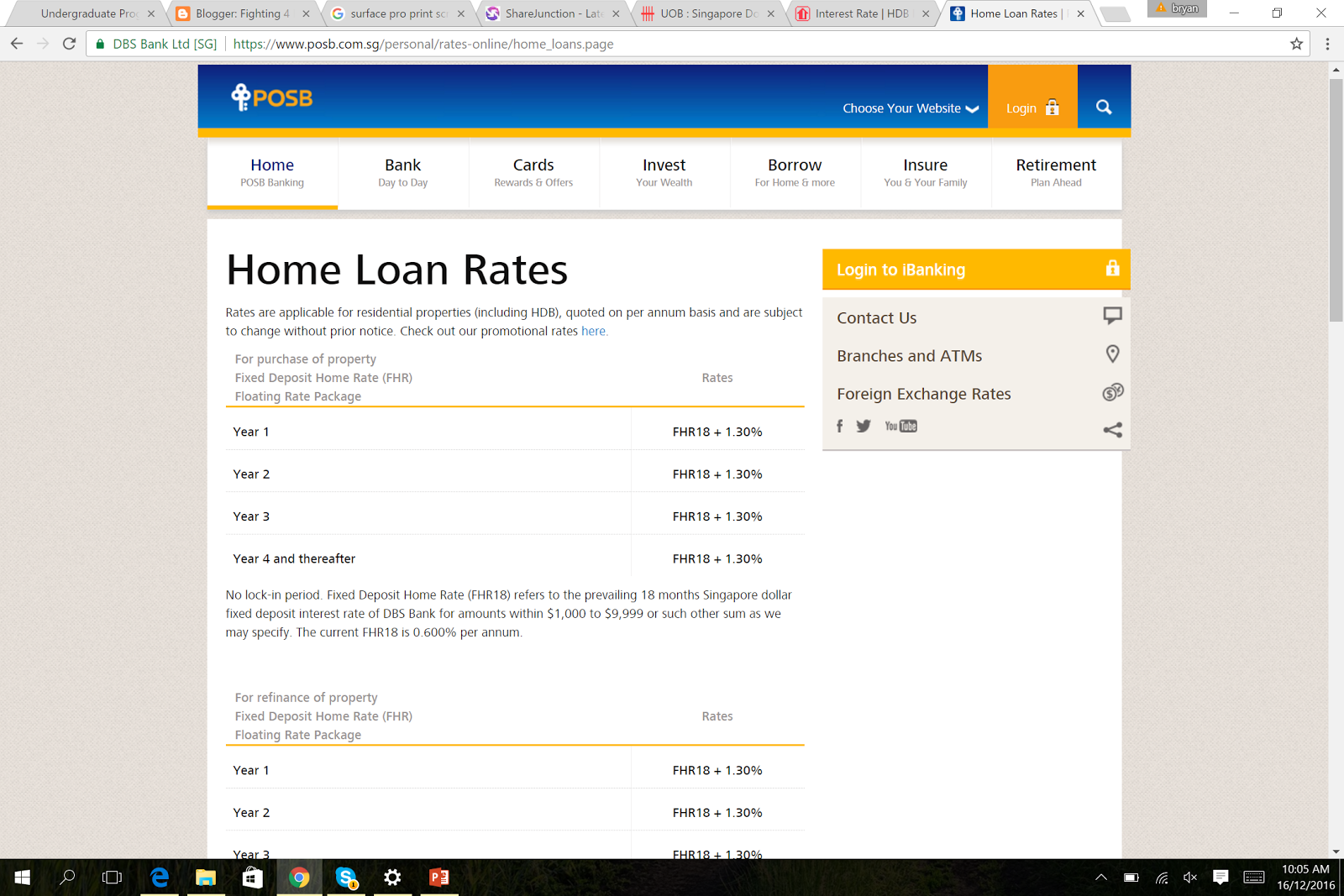
2. CPF Concessionary Housing Loan will really be concessionary. For the longest time, we wonder how is the home loan offered by HDB concessionary. Home loan interest rates offered by private banks have been lower than the 2.6% that HDB is charging, and it seems like people who took up HDB loan have been taken for a ride. Further, banks have came up with innovative products that peg mortgage rates to fixed deposit rates, not dissimilar to how OA rates is calculated. While this might provide more stability than products pegged to SIBOR or SOR, they aren't actually better than HDB housing loan in a high interest rate environment. Let's take a look at the FHR mortgage provided by POSB.


The FHR-18 home loan rate is calculated by taking the prevailing 18 months SGD fixed deposit rate offered by DBS bank for amounts within $1,000 to $9,999, and adding 1.30% to it. This is inferior to the HDB loan in a few ways:
  • The rates for 18-month fixed deposit is likely to be always higher than the 12-month fixed deposit rates used to compute CPF OA interest. For comparison, the current 18-month fixed deposit rate is 0.60%, as opposed to the 12-month rate of 0.35% (for DBS).
  • While the home loan provided by POSB adds 1.30% to the FHR18, HDB only adds 0.10% to the CPF OA rate.
  • CPF OA rate takes into account savings deposit rate using the formula: 80FD:20SD. Since SD rates are always lower than FD's, the resulting rates will be lower.
What this means is that once the 18-month fixed deposit rate exceeds 1.30%, interest rate of this particular product will be higher than that of HDB concessionary loan. Now we see how HDB Concessionary Loan gets its name.
3. Cash will give you higher risk-free returns than balances in CPF OA accounts. Due to the 80FD:20SD formula used to compute CPF OA rates, balances in OA will yield slightly lower returns compared to a pure 12-month FD. The gap will be even wider if you compare to a 36-month FD. Further, cash in FD affords you greater liquidity than balances in CPF OA. There will really be no reason why you would prefer CPF OA over cash parked in FD.

SO WHAT DOES THIS MEAN TO US?

If you expect interest rates to stay long for another decade, then what we have been used to thinking doesn't change. That is, we should continue to:
  • choose to take up home loan from banks instead of from HDB.
  • pay down our housing loan using cash as fast as we can to save on interest expense
  • use cash to make our monthly mortgage payment if you can afford to, and let your OA balances compound (assuming you are only interested in risk-free instruments, so stocks/REITS or other more risky investments are out of your radar)
However, if you think interest rates will rise soon, then we should start questioning the "conventional wisdoms". We've been in a low interest rates environment for far too long, and we are starting to take it for granted. If rates are to rise, we should do the following:
  • choose HDB Concessionary Loan over banks' home loans. 
  •  your mortgage loan should stretch out for as long a period of time as HDB is willing to grant you. Interest expense incurred can be easily covered by the interest earned from FD.
  • use your OA balances for mortgage repayment as much as you can. Keep your cash for FDs, which are likely to earn you more interests, albeit marginally. 

ADOPTING A BALANCED APPROACH

The above are some actions that we can take under the two extreme scenarios. However, none of us can predict with certainty what the future might look like. Our best bet is to take a balanced approach and hedge our positions. If you have $100k of excess cash to pay down your mortgage, why not just do $50k first, and keep the remainder as cash just in case? There is no right answer to this really, it depends on what you are comfortable with, and where your conviction lies.

What I hope this article will achieve is to remind all of us that, while we are very used to, in fact, too used to a low interest environment, there is this other side of the coin that looks vastly different. When we take up a mortgage loan, choose to pay down our loan, and make voluntary contributions to our CPF accounts, we are committing to decision that cannot be easily unwound. It is thus prudent to consider the merits of our choices under different but entirely plausible circumstances, and thereafter calibrate our decisions accordingly.

Voluntary Contribution to CPF Special or Retirement Account - Not As Easy Emotionally As I Believed

Save for your retirement and save on taxes - only available in Singapore.inc.

Sometime in June this year, I blogged about how anyone in similar situation as mine can instantly get 7.53% capital gain and a 5.38% yield on capital per annum [link]. It was easy going through the fancy numbers and writing about it, but to actually put the plan to action? Tough. No matter how impressive the plan looks on paper, the idea of locking up my money for the next 15 years and never getting them back in full doesn't really sit well on me emotionally. It feels like I'm "giving away" my money, and who does that?

But as much as I hated that feeling of parting with my hard-saved money, I knew I had to stick to my plan if I am serious about securing my financial future. So I bit my tongue and took the plunge, contributing $200 to my mum's SA a few days later. Yes, a grand total of $200. This is the first time I am using the e-cashier platform on the CPF website; it's only prudent to test it out first. Expectantly, the money appeared in my mum's CPF account a few days later.

Then, here comes the hard bit. I intended to contribute a total of $7000 to my mum's CPF to maximize my tax benefits, which left me with $6800 more to go! Okay well, to some of the higher-income earners out there, maybe this does not sound much to you, but it's sizable and significant to me. You know how sometimes people can conveniently leave a $2 note in a corner of their house and forget about it? $6800 is not that to me. $6800 is an amount I will safe-keep in a strongbox made of 10 cm thick fire-resistant alloy that's hidden in the most concealed corner of my house and drilled to the wall with a pair of 10 cm long screws. Yes, it's exactly that, and now you can see how difficult it is for me to use that money to buy a golden egg that will only hatch 15 years year. In fact, it's so difficult that I actually put the plan on hold for the next 1 month.

In that 1 month, I kept looking for reasons not to follow through with the plan. I could not find one compelling enough.

So again, I bit my tongue for the second time and made a contribution of $2800. The money appeared where it should a few days later.

With $4000 left to go, I sat on the plan yet again. I sat on it so much that I nearly developed piles. Eventually, I got so sick of sitting and the risk of actually developing piles got so high that I went back to biting my now-swollen tongue instead and made my final contribution of $4000.

And now I can rest and prepare myself for the next round of tongue-biting and piles-developing exercise. I hope it gets easier.

7.53% Instant Capital Gain + 5.38% Yield on Capital


Is there an investment that gives you an instant 7.53% capital gain + a minimum yield on capital of at least 5.38% for the next 15 years? Sounds too good to be true? Read on to find out more!

I haven't given much thought to this excellent long term "investment" previously, but ASSI's blog post on "How Younger Members can Get 6% per year from the CPF" inspired me to dig deeper and think harder. Yes, like what most of you seasoned personal-finance gurus would have figured out already, this investment is our CPF.

Before I came across the article, I only thought about contributing to my own CPF to get the 4%  that our Special Account (SA) is yielding. But because I am 4 decades away from retirement, have a huge mortgage to service, a 10-month-old daughter to feed, and 2 aging parents who aren't quite prepared for their own retirement, I put off the idea.

But what if there is a new variety of seeds that will start to bear fruits in 15 years time? What if there is a 7% early bird discount now? Will I buy those seeds to plant them today? I am very tempted to.


Let me first explain how I got the numbers.


If I make a cash top-up to my loved ones' SA, I get to enjoy tax relief of up to $7000 per calendar year. In my latest year of assessment, after all the reliefs I qualify for, my chargeable income is between $40k to $80k. This means that if I were to contribute $7000 to my mum's SA, I will pay $490 lesser in tax (source: IRAS). Essentially, this is like getting $490 for free from the government if I put in $6510, or a 5.38% gain in capital immediately (490/6510 x 100%). Got freebies who don't want???  
*do note that any contribution above the Full Retirement Sum is not eligible for tax reliefs. My mum has (only) $12k (after checking, I realised she only has 2k, but nevermind, we can assume she has 12k for the subsequent illustrations in this post.) in her CPF, so I don't have to worry about that.

Tax relief for the giver? It's like free money from the government!

What about the 5.38% yield on capital that I purported above then? If you look at the footnote# under the table in the print screen above, the first combined balances of up to $60k attracts an additional 1% interest. This means that for my mum who just turned 50 this year, balances in her SA will earn 4+1 = 5%! But remember my capital outlay was only $6510? That gives me a yield on capital of 5.38% (350/6510 x 100%). Okay, I am really just playing with numbers here, but it really does sound like a good deal, doesn't it? Moreover, the interest rates will be bumped up to 6% for the first $30k when she turns 55.

So what's the game plan?


Given that I only qualify for 7% discount every year on the first $7000, with the likelihood of the discount getting bigger in the years ahead (pay rise, yay!), I am inclined to spread out my contribution.

Let's run some numbers.

8th Wonder of the World, indeed.

Let's assume that my mum has $12k to begin with, and I start my yearly contribution of $7k just before she turns 51. This will last for 5 years. Thereafter, I will not contribute anymore.

Total capital outlay (after tax relief): $12,000 + ($6510 x 5) = $44,550
Balance at beginning of 65 (after compounding for 14 times) = $89,495.29

Not bad. Almost hitting the Basic Retirement Sum of $93,215 for her cohort.

How much can she expect to get every month?


Referencing the Straits Times article published on 23 Aug, 2015, the amount one can expect to receive per month on the Basic Life plan is about $650. (I will talk about why I prefer Basic Plan over Standard Plan in another post) This is based on $80,500 being set aside at age 55. I have no idea how the smarties in CPF or MOF came up with this numbers, and I concede that I am not half as smart as them. So how? How can a layman like me estimate the amount that my mum can expect to receive?

Let's try two methods:

First Method: Proportionality. 
If $80,500 set aside at 55 results in about $650 a month from 65 onwards, $53,265 will result in...

(53,265/80,500) x 650 = $430

Second Method: Use the tools provided by CPF here, but tweak the inputs.
The tool only works for those who are between their payout eligibility age and 80 years old. For my mum's case, the tool doesn't work, but I can cheat the system a little to get an estimation.

Since we've already computed the amount she will have in her RA when she hit 65, I will simply assume that she has already hit 65 this year (means the year of birth is in 1951). The amount in her RA, I will input as $89,495 as computed.

Next, the tool will ask you for your annual assessable income and annual property value. This is to determine if you qualify for CPF Life Bonus. My mum does not, so I chose the highest range for both so no bonus will be included in the calculation.

Nope, my mum doesn't qualify for CPF Life Bonus.

The result? She will receive about $444 a month. Not too far off from my first method, so I think it's rather safe to assume that she will receive slightly more than $400 monthly from 65 onwards.

Is this a good amount? I think it's not too shabby. It's not enough for sure, but it can certainly help to ease the financial burden a little.

What do you think? Are any of your parents without much money in their CPF? Maybe this might work out for you too.